

Heavy construction equipment faces regular exposure to harsh weather and other rough conditions, which can lead to wear and tear. A preventive maintenance program for your heavy equipment is non-negotiable if you want to maximize uptime and make the most of your investment in your fleet.
In this guide, we provide maintenance tips to help you standardize your processes, as well as a ready-to-use construction equipment maintenance checklist.
Key takeaways
- A comprehensive heavy equipment maintenance checklist covers visual inspections, fluid levels, hydraulics, and other areas.
- A construction equipment maintenance checklist helps keep all machines, from excavators to generators, safe, efficient, reliable, and compliant.
- A CMMS is the best way to track checklist action items, integrate tasks with the rest of your maintenance workflow, and streamline routine maintenance management.
How to use this checklist
Our routine maintenance checklist template includes generic maintenance tasks for various types of construction equipment. You’ll need to tailor it to the specific needs of your fleet. Here are some tips for making the most of it.
Customize your checklist
After you download our construction equipment maintenance checklist, the first step is to customize it. Remove tasks that aren’t relevant to your equipment portfolio, add missing ones, and tweak the rest.
Implement and monitor tasks
Once you’ve customized your checklist, it’s time to put the wheels in motion. Assign each maintenance task to a technician based on their skills and availability. Monitor the progress of the checklist to prevent backlogs and keep your heavy construction equipment in good shape.
Use a CMMS
A computerized maintenance management system (CMMS) is the Swiss Army Knife of modern maintenance operations. Using this checklist with a CMMS will save you time tracking action items and creating a manual audit trail; you can also use it to assign technicians, alert technicians when tasks are assigned or overdue, and track real-time progress on routine maintenance items.


What’s included in a construction equipment maintenance checklist?
Let’s look at some maintenance tasks and equipment you need to cover in your checklist.
Visual inspections
Inspect your construction equipment for signs of damage, including cracks, leaks, loose bolts, worn tires, damaged hoses, or missing guards.
Fluid levels and lubrication
Check and top off engine oil, coolant, transmission fluid, brake fluid, and hydraulic oil, and use the grades the manufacturer specifies. If the machine uses selective catalytic reduction (SCR) to control emissions, check the diesel exhaust fluid (DEF) level as well. Letting the DEF tank run dry triggers a derate that cuts engine power until the tank is refilled. When greasing, follow the manufacturer's intervals and apply the specified amount. Too little grease lets joints and bearings wear prematurely, while too much can blow out seals and pack dirt into fittings.
Electrical and safety systems
Check your electrical and safety systems and make sure they’re functional. Inspect wiring for wear and corrosion, test warning lights, alarms, and backup cameras, and confirm that fire extinguishers and first-aid kits are accessible.
Engine and drivetrain
Check belts and air intakes for wear or blockage, and ensure that the engine runs smoothly without excessive smoke or vibration. Where fitted, watch the diesel particulate filter (DPF) indicators, let automatic filter cleaning run, and schedule ash service on the manufacturer’s interval.
For the drivetrain, inspect gearboxes, axles, and transmission for leaks or abnormal noise.
Hydraulic and pneumatic systems
Check hoses, fittings, seals, and cylinders for leaks, cracks, or pressure drops. Make sure the hydraulic filters are clean and fluid pressure is within spec.
Operator controls and cab
Verify that all control levers, pedals, and gauges work properly. Inspect seats, mirrors, HVAC systems, and seatbelts to ensure the operator’s work environment is safe and comfortable.
Heavy equipment maintenance checklist
Here’s what you need to do to keep your heavy machinery in good health and ensure operator safety:
Earthmoving equipment (excavators, bulldozers, loaders, graders)
Material handling equipment (cranes, forklifts, telehandlers)
Hauling equipment (dump trucks, articulated trucks)
Support equipment (generators, compressors, mixers, pumps)
Common daily, weekly, and monthly maintenance tasks
Here’s a typical daily, weekly, monthly, and seasonal cadence for maintaining your heavy construction equipment.
Daily maintenance steps
Weekly maintenance steps
Monthly maintenance steps
Seasonal maintenance steps
Spring
Summer
Fall
Winter
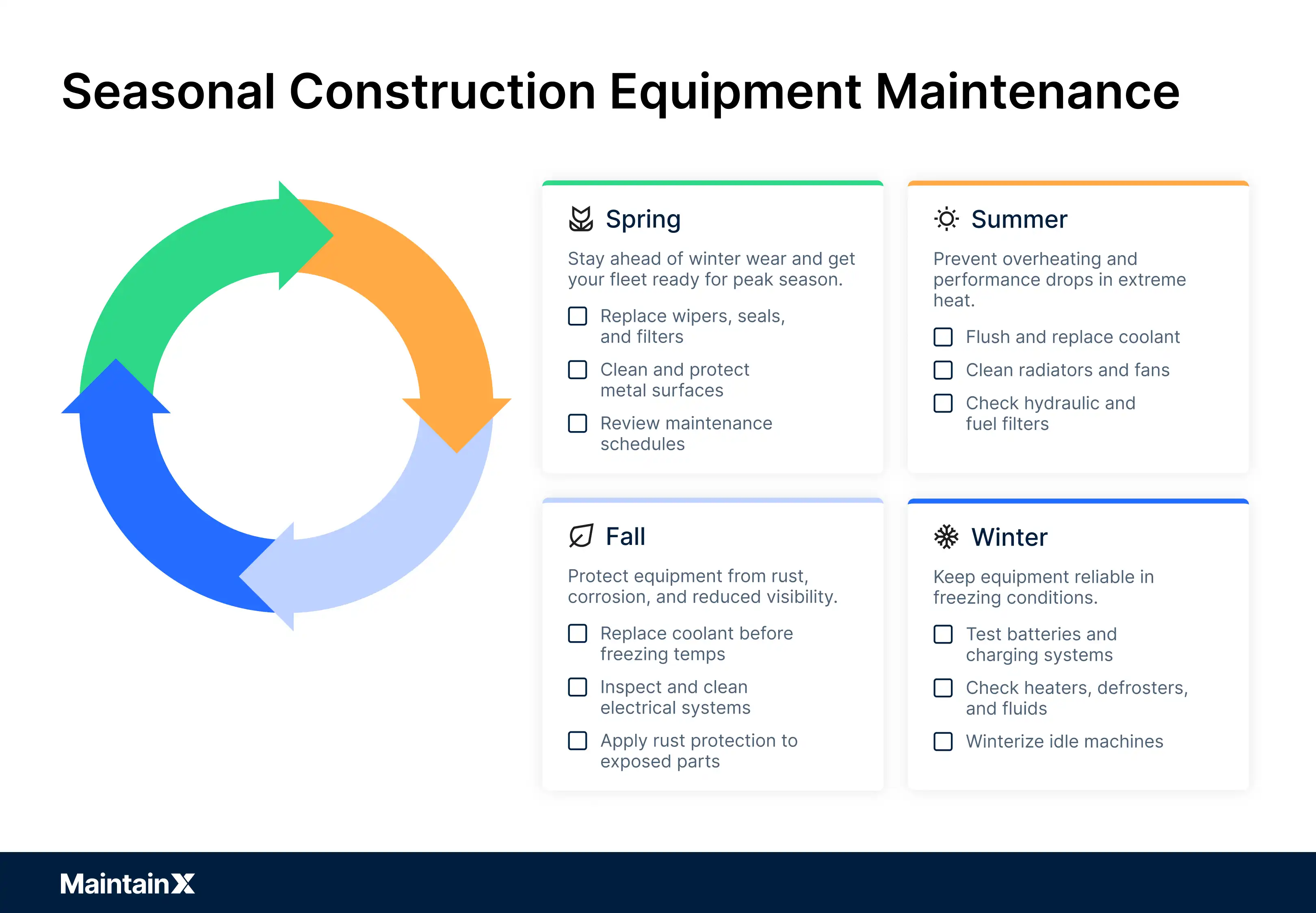
*Disclaimer: This checklist is to be used only by those with appropriate training, expertise, and professional judgment. You are solely responsible for reviewing this checklist to ensure that it meets all professional standards and legal requirements, as well as your needs and intent.
How to maintain equipment on a construction site
A checklist sets the tasks, but whether they happen depends on what your crew does on the jobsite. These six habits keep your machines serviceable between scheduled maintenance.
1. Walk around every machine before the shift
Before a machine starts work, the operator should walk around it and check the brakes, tires, horn, steering, seat belts, controls, and safety devices. Look for fresh leaks and any damage from the previous shift, and have operators get down low to check underneath before they sign off on the inspection.
For on-site vehicles such as trucks, OSHA's motor vehicle standard (1926.601) requires these checks at the start of every shift. Cranes have their own rule: under OSHA's crane inspection standard (1926.1412), a competent person must begin a visual inspection before each shift the crane is used. Even where no rule requires it, a daily walkaround is the cheapest way to catch problems early.
2. Take a machine out of service when a check fails
If an inspection turns up a safety problem, park the machine until it's fixed. OSHA requires this for some equipment: on-site trucks and other motor vehicles must have defects corrected before they go into service, and cranes with a hazardous deficiency stay out of service until it's corrected. It's a sound rule for every machine in your fleet.
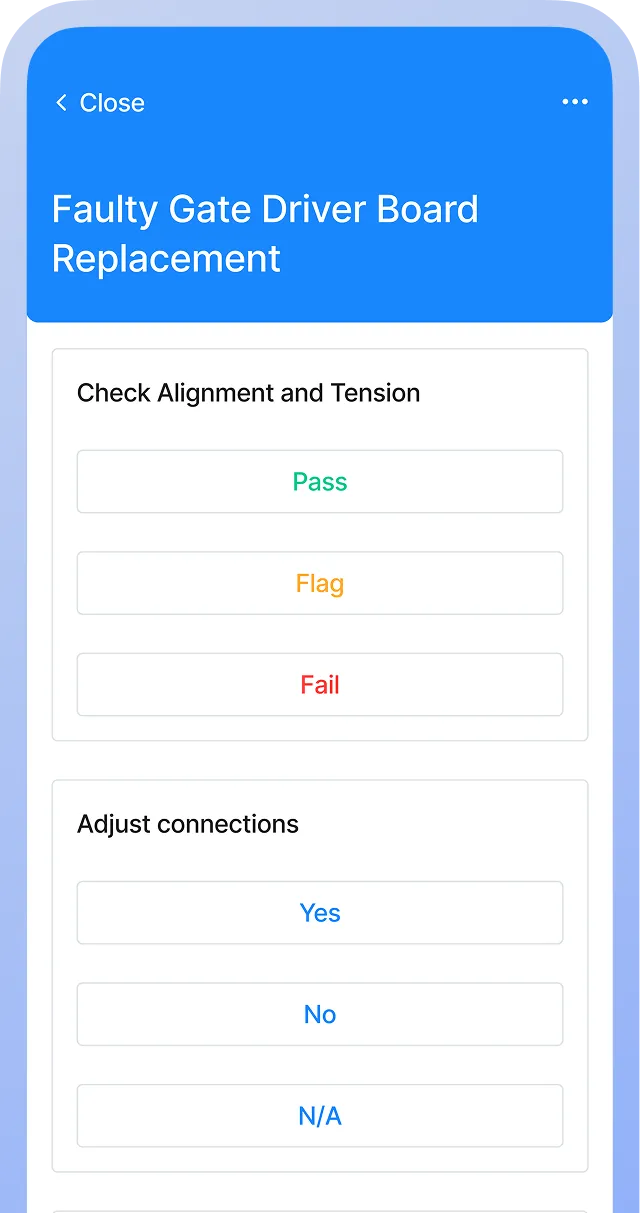
You should also make it easy for operators to report a problem the moment they find it. In MaintainX, operators complete digital inspections in the mobile app, and you can set a failed item to automatically create a work order and alert your maintenance team. Once a problem is reported, tag the machine at the controls and remove the key so no one else starts it before the repair is done.
3. Lock out and tag out before on-site repairs
An unexpected startup or release of stored energy during servicing can cause serious injury or death, so isolate every energy source before anyone works on a machine. For electrical equipment, OSHA's lockout and tagging standard (1926.417) requires deenergized equipment to be rendered inoperative and tagged at every point where it could be energized.
Apply the same thinking to hydraulic pressure and raised attachments: bleed off pressure and lower or block anything that could move. Our guide to lockout/tagout procedures covers the steps.
4. Park, lower, and shut down
When you park a machine, set the parking brake, and chock the wheels if it's on an incline. Whenever a machine is being repaired or isn't in use, fully lower or block its blades, buckets, and dump bodies, with the controls in neutral and the motor stopped. OSHA's construction equipment standard (1926.600) covers both requirements. At the end of the day, also clear mud from the tracks and undercarriage before it hardens.
5. Shut the engine off to refuel
OSHA's flammable liquids standard (1926.152) requires equipment motors to be shut off during fueling, and that includes quick top-offs between tasks. Make engine-off the first step in your fueling procedure for both fuel truck drivers and operators.
6. Cut idle time
Idling burns fuel and racks up engine hours without doing any work, which brings hour-based service intervals due sooner. Many newer machines have auto-idle, which drops engine speed when the controls sit unused, and auto-shutdown, which turns the engine off after a set idle period. Turn on these features where your fleet has them, and track engine hours so you know when service is due.
How to track and document maintenance activities
Accurate documentation helps you gauge your maintenance program’s efficiency and comply with regulations. There are two ways to track and document your maintenance work. Let’s look at both of them.
Using a CMMS
Once you’ve imported your maintenance checklist into a CMMS, the next step is to add instructions as per your standard operating procedures (SOPs) so technicians don’t have to guess what they need to do. After adding instructions, assign each task to a technician based on skill and availability.
The CMMS notifies technicians when a maintenance task is assigned or overdue. Technicians can then log their progress via a mobile app so you can track things in real time.
Your CMMS also collects data that helps analyze maintenance performance and serves as an audit trail. All maintenance tasks are tied to a work order, which means you can review every task performed from the moment the work order was created through to completion. This includes parts used, team members involved in the work order, and any communication between team members.
Using a spreadsheet or printed checklist
This is the less efficient, less auditable option.
If you go this route, you’ll need to confirm with a technician that tasks were completed, manually check off tasks on the spreadsheet or paper, and use macros on the spreadsheet to build an audit trail. This approach is time-consuming and creates room for human error.
Heavy equipment maintenance best practices
There are a few steps you can take to create a comprehensive checklist, minimize mistakes, and achieve the best possible outcomes from your maintenance program. Here are some best practices to keep in mind:
- Understand your regulatory obligations: Know which rules apply to your fleet. For example, OSHA 29 CFR 1926.601 requires shift-start checks on on-site trucks and other motor vehicles, while cranes have their own inspection rules. Requirements also vary by industry, region, and application.
- Follow manufacturer guidelines: Manufacturers publish service intervals, fluid and parts specs, and inspection procedures for each machine. Use them as the baseline for your checklist.
- Plan for seasonal or environmental conditions: Cold, heat, dust, moisture, and corrosive environments can put your equipment’s health at risk. We’ve covered many of these in our seasonal maintenance checklist, but be sure to adjust based on your operating conditions and equipment.
- Keep detailed maintenance records: Make sure you log inspections, repairs, parts replaced, fault codes, downtime, and operator notes.
- Train operators properly: Your operators have to know how to perform and record each task on the checklist before it does any good. Train your operators on each task and conduct reviews after implementing the checklist to make sure they’re following your SOPs.
- Monitor performance metrics: Define KPIs and use a CMMS to track them. Use this data to identify trends and issues before they cause major failures.
- Manage your parts inventory: Stock the filters, belts, hoses, and wear parts your fleet uses most, and set a minimum quantity for each. Log parts on work orders so your reorder points follow actual use. Our guide to spare parts inventory management strategies covers the details.
- Review your records every week: Set aside time each week to look at overdue preventive work, open defects, and repeat failures. This review catches problems a single inspection won’t show, such as a loader that returns to the shop three times with the same hydraulic leak.
Several of these practices, from tracking KPIs to weekly reviews, depend on accurate, current records, and a CMMS gives your team one place to keep them.
Why use a CMMS for construction equipment preventive maintenance tracking?
A checklist protects your fleet only if the work runs on schedule and the technician has the checklist at the machine. The MaintainX CMMS platform automates preventive maintenance by time, meter readings, or condition. When a machine's engine hours sync from a telematics system such as Verizon Fleet, Samsara, or Motive and reach its service interval, MaintainX creates the work order.
Your checklist becomes a procedure attached to each work order, and MaintainX's AI can draft that procedure from an existing PDF checklist or manual for you to review and refine. On a jobsite with a weak signal, technicians can work offline in the mobile app and sync when they reconnect.
To see how MaintainX can support your crew, learn more about our fleet maintenance solutions or book a demo to speak with our team.
Construction equipment maintenance FAQs
What is preventive maintenance for construction equipment?
Preventive maintenance involves proactively maintaining equipment before a failure occurs. It includes checking fluid levels, replacing filters, lubricating components, and inspecting critical parts. The goal is to increase equipment life, improve safety, and reduce downtime through effective maintenance practices, which can also help avoid costly repairs.
How often should construction equipment undergo preventive maintenance?
The frequency depends on multiple factors, including the type of equipment, usage hours, manufacturer recommendations, and operating conditions. In general, inspections should be conducted daily, with more thorough servicing performed on a weekly, monthly, or seasonal basis. Equipment in high use or operated in harsh environments may need shorter intervals. The best policy is to use the OEM’s recommended maintenance schedule.
What are the key components to inspect during preventive maintenance?
Key components to inspect include the engine and drivetrain, hydraulic systems, electrical systems, brakes and steering, tires or tracks, and safety controls. You should also check fluids and filters, and replace them as needed.
How can I track and document maintenance activities?
The best way to track and document construction equipment maintenance activities is to use a CMMS. A CMMS records inspections, repairs, parts used, and upcoming service dates. This makes it easier to monitor preventive maintenance work, maintain compliance and generate insightful reporting.
What are the benefits of a preventive maintenance checklist?
A preventive maintenance checklist ensures consistency and minimizes human error. It standardizes your heavy equipment maintenance process, helps track maintenance tasks, and maintains accurate records, resulting in increased uptime and improved safety.
Can preventive maintenance prevent unexpected breakdowns?
Yes. While there’s no guaranteed method to eliminate all failures, preventive maintenance significantly reduces the risk of unexpected breakdowns. Regular inspections and servicing catch small issues like leaks, cracks, or worn parts before they lead to equipment failures and cause major damage. Consistent maintenance is the most efficient way to ensure uptime and reliability on construction sites while also reducing safety risks.

Marc Cousineau is the Senior Content Marketing Manager at MaintainX. Marc has over a decade of experience telling stories for technology brands, including more than five years writing about the maintenance and asset management industry.

.webp)