

Only 28% of maintenance teams report actively using reliability-centered maintenance (RCM) today, according to MaintainX's 2026 State of Industrial Maintenance report. However, RCM solves a problem most teams are stuck in: treating every asset the same way instead of matching maintenance effort to actual risk and cost.
This article walks through a complete worked example, from failure mode to finished job plan, giving you a repeatable way to turn any failure mode into a specific, justified maintenance strategy. You’ll get a maintenance plan that helps you reduce unplanned downtime without over-maintaining low-risk assets.
Key takeaways
- RCM turns your existing FMEA and criticality scores into a specific maintenance strategy.
- A completed RCM analysis is only as useful as the system that acts on it. A CMMS like MaintainX turns the strategy you land on into scheduled work orders, condition-based triggers, and tracked compliance.
- RCM works best as a living process where you revisit failure modes, thresholds, and strategies on a set cadence rather than treating it as a one-time exercise.
What is an RCM template?
An RCM template is a working document that provides the structure required to conduct an RCM analysis on a specific asset. It includes fields for logging identified failure modes, a fixed decision logic for classifying each failure mode into a maintenance strategy, and space to translate that strategy into an executable job plan.
Implementing RCM allows maintenance teams to allocate resources according to asset criticality rather than applying a uniform maintenance schedule across the board. Critical assets receive the monitoring and response time their failure consequences warrant, while low-risk assets can be run to failure without unnecessary preventive work. For the full framework behind this decision logic, see our guide to reliability-centered maintenance.
Where RCM fits with criticality and FMEA
RCM sits after criticality and FMEA in the analysis process. Most maintenance teams will work through three steps in order:
- Criticality assessment: Determine which assets warrant attention first, ranking equipment by the consequence of failure across safety, production, and cost.
- FMEA: Score the specific ways each critical asset can fail, quantifying severity, occurrence, and detectability into a risk priority number (RPN).
- RCM: Decide what to actually do about each failure mode, given its RPN. The first two processes don't answer this on their own.
RCM does not replace criticality assessments and FMEA. Instead, view it as the decision layer that sits on top of them, turning the data that criticality and FMEA produce into an efficient maintenance strategy.
The RCM worksheet does not ask you to re-score severity, occurrence, or detection because those numbers come from your FMEA and should be imported, not recalculated. If you haven't completed a criticality assessment or FMEA yet, MaintainX's criticality assessment guide and FMEA guide can help you generate that data first. A rough High, Medium, or Low criticality call is enough to get started if a formal assessment isn't in place yet.
How to use the RCM template
The template has five steps and is designed to cover one asset, with room for up to three failure modes. You'll record the asset's details, bring in failure mode data from your FMEA, run each failure mode through the decision logic, and finish with a job plan a technician can execute, then review whether the strategy is working.
1. Complete the asset header
The first section of this worksheet is designed so you can quickly identify key asset information. Fill in these details:
- Asset ID
- Location
- Criticality tier (High, Medium, or Low)
- Completed by
- Date
Criticality tier is the field you're most likely to need to look up. If you've already completed a criticality assessment, pull the tier from there. If not, make a rough call based on how a failure would affect safety and production, and refine it later.
For the rest of this guide, we'll use a 50 HP TEFC induction motor driving a production conveyor as the running example. It's rated High criticality because a failure would stop production, and its highest-RPN failure mode is bearing degradation, which we'll carry through each step.
2. Fill in failure mode data
Start with the top of the block, which comes straight from your FMEA. This is where you name the specific way the asset fails, so that everything you decide in the rest of the block is tied to a specific, already-scored risk:
- Failure mode: A specific way a component fails and causes the asset to stop performing as needed.
- Cause: Why the failure mode happens. Aim for the root cause, which you can get from a root cause analysis.
- Effect: Describe the effect at the level of what a technician or operator would notice.
- RPN: The risk priority number from your FMEA (severity × occurrence × detection). Enter it as-is. Don't re-score severity, occurrence, or detection here, since that duplicates the FMEA and can leave the two documents out of sync.
For our conveyor drive motor's bearing degradation, the block would read:
- Failure mode: Drive-end and opposite-drive-end (DE/ODE) bearing degradation
- Cause: Insufficient lubrication
- Effect: Increased vibration, then eventual seizure and loss of belt speed
- RPN: 160 (imported from FMEA)
3. Apply the decision logic
Once the failure mode block is filled in, answer all five Yes/No questions. The first question you answer Yes to, in order, determines your strategy, so you don't have to weigh trade-offs yourself. The one exception is safety or environmental consequence: A Yes there doesn't give you a strategy on its own. It just means a task is mandatory, so the strategy comes from the next Yes.
If none of the remaining questions resolves to Yes, the strategy is redesign, since a safety or environmental risk can't be left as run-to-failure.
Here’s what that would look like for our running example.
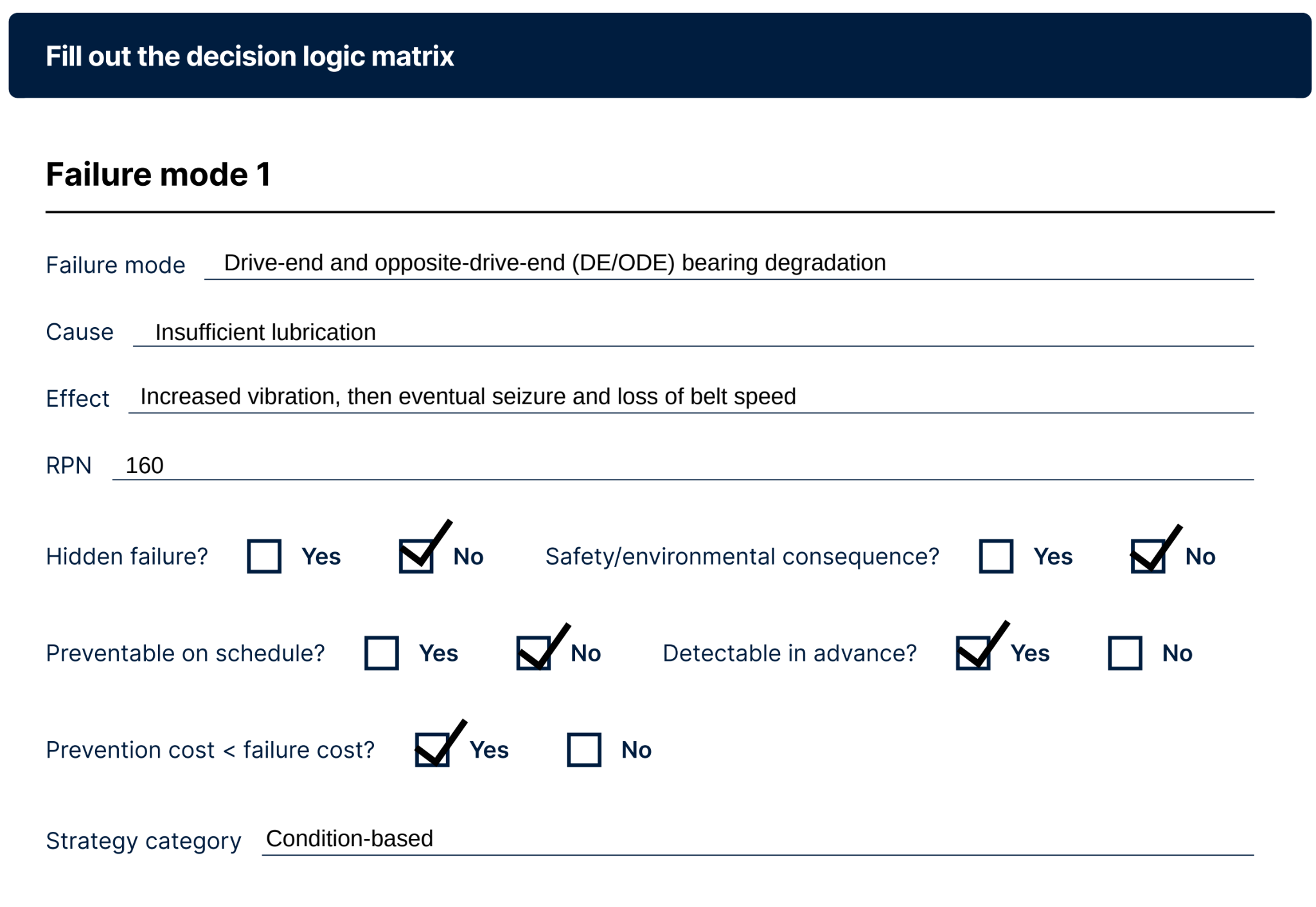
Even with regreasing on a fixed interval, bearing wear on this motor doesn't follow a predictable enough pattern to schedule around, but it does give a clear vibration and ultrasound warning well before seizure.
The worksheet has room for three failure modes. If your FMEA lists more, start with the highest RPNs and use a second copy for the rest.
4. Build the job plan
Once you have a strategy category, turn it into something a technician can execute. Page 3 has room for two job plans, each built around the same core questions: who does what, how, and how often.
Start with the job plan ID and which failure mode it addresses, so the plan can be traced back to the block it came from. Then fill in the method and frequency, including what will be done and on what interval. This is where your strategy category from step 3 matters: Preventive and condition-based strategies get a method and frequency you can write straight into the job plan, using the table below for reference.
For the conveyor motor's bearing degradation, a condition-based strategy becomes a specific task: monthly ultrasound and a quarterly IR scan, with action triggered at more than 7 mm/s overall vibration or a rising ultrasound trend. Lubrication follows the same logic: regrease based on ultrasound readings rather than a fixed interval, so the bearing gets grease when it needs it, not when the calendar says so.
Next, note any safety or LOTO requirements the task carries, and break the task itself into a short numbered list of steps a technician can follow. Close with pass/fail criteria specific enough that two different technicians would reach the same conclusion, and name an owner so the task doesn't fall through the cracks.
Once the job plans are complete, sign and date the worksheet so there's a record of who approved the strategy and when. Use the additional notes field for anything that doesn't fit elsewhere, such as the rationale behind a run-to-failure decision or a redesign that's been routed to engineering.


5. Review and verify
Review each completed worksheet quarterly to check whether the strategy you selected is actually working. Track these KPIs for the asset:
- PM compliance %
- Failed inspections
- Condition trends (such as vibration)
- Unplanned downtime hours
- Maintenance costs
Use what you find to refine the plan. For the conveyor motor, if ultrasound flags dust ingress every cycle, the fix is a shroud or filter upgrade, not repeating the same task. After any failure, run a brief root cause analysis and adjust thresholds or frequencies on the worksheet.
Common mistakes when using an RCM template
When completing the RCM analysis, watch for these common mistakes:
- Re-scoring severity, occurrence, or detection instead of reusing FMEA output. Recalculating those numbers inside the RCM worksheet duplicates work already completed and risks inconsistent scores between the FMEA and the RCM analysis.
- Skipping the hidden-failure question. It is easy to focus on failures that surface during normal operation and overlook protective or backup equipment, such as a standby pump or a safety interlock, that only reveals a failure when called upon. These hidden failures often carry the highest consequence precisely because they go unnoticed until it is too late.
- Treating RCM as a one-time analysis. Failure modes, thresholds, and operating conditions change over time, and a strategy that was correct a year ago may no longer be appropriate.
- Never entering the selected strategy into a PM schedule. An RCM worksheet that sits in a folder does not reduce downtime. Only a job plan that a technician actually executes does.
Avoiding these mistakes requires treating the RCM worksheet as one component of a larger maintenance program rather than a standalone exercise. The analysis is only as valuable as the discipline applied to keeping it current and the systems in place to act on its conclusions.
How a CMMS supports RCM
An RCM analysis produces a strategy, a trigger, and an owner. A CMMS turns that output into scheduled, trackable work.
Once a strategy is selected, a CMMS can convert it directly into a maintenance plan: A preventive strategy becomes a scheduled PM triggered by a calendar interval, while a condition-based strategy becomes a task triggered by a meter reading or sensor threshold. Instead of relying on someone to remember when a task is due, the system generates and assigns the work order automatically.
A CMMS also gives you the data needed for regular reviews. Tracking metrics like mean time between failures (MTBF), mean time to repair (MTTR), and PM schedule compliance by asset shows whether a selected strategy is actually working or needs to be revisited.
See how MaintainX can turn your RCM strategy into scheduled, trackable work by booking a tour with our team.
Reliability-centered maintenance FAQs
How do you decide which assets to include in an RCM program?
Start with assets that have the highest impact on safety, compliance, or production. A simple criticality analysis helps—score assets by consequence of failure, downtime cost, and repair lead time. High-risk or high-cost assets are ideal RCM candidates. Low-consequence assets (like non-critical lighting) can be managed with basic PM or run-to-failure, freeing up resources for where RCM makes the biggest impact.
What are the main benefits of reliability-centered maintenance?
The biggest wins include:
- Fewer unplanned outages thanks to condition-based tasks
- Reduced maintenance costs by eliminating unnecessary PMs
- Better safety and compliance through structured failure analysis
- Longer asset life from proactive monitoring and timely interventions
- Higher wrench time because planners and technicians focus on tasks that matter
The RCM process aligns maintenance strategy directly with business goals—higher uptime, safer operations, and more predictable costs.
Is RCM too complex for small maintenance teams?
Not at all. Small teams can benefit even more because resources are limited. You don’t need a full-blown FMECA to start—just pick your top 5–10 critical assets and walk through the RCM process. Even a “lightweight” RCM approach helps prioritize the right maintenance and avoid wasted effort. Over time, you can expand the scope as your team and data mature.
How often should an RCM strategy be reviewed or updated?
RCM is not a one-and-done project—it’s a living program. Review maintenance strategies at least quarterly to adjust intervals, thresholds, and job plans based on what’s actually happening in the field. Any time you add new equipment, see recurring failures, or adopt new technology (like sensors or predictive analytics), revisit the RCM analysis. Continuous feedback is what keeps an RCM process effective.
What's the difference between an RCM template and an FMEA template?
An FMEA template is used to identify and score failure modes, quantifying severity, occurrence, and detectability into a risk priority number (RPN). An RCM template is used after the FMEA is complete. It takes those RPN scores and applies decision logic to determine the appropriate maintenance strategy for each failure mode. The FMEA tells you what can go wrong and how bad it would be. The RCM template tells you what to do about it.
What’s the difference between reliability-centered maintenance (RCM) and preventive maintenance (PM)?
Preventive maintenance assumes fixed time/usage intervals. RCM (reliability-centered maintenance) originated in the aviation industry, where safety concerns and complex failure patterns led to the development of more strategic maintenance practices. RCM uses a logic tree to pick the most effective tactic per failure mode: condition-based, interval-based, redesign/accept risk, or run-to-failure.
Do I need to complete a criticality assessment before RCM?
A formal criticality assessment is recommended but not strictly required to get started. At minimum, you should have a rough High, Medium, or Low criticality rating for the asset before applying RCM decision logic, since criticality directly affects how the safety and environmental consequence question is answered.

Marc Cousineau is the Senior Content Marketing Manager at MaintainX. Marc has over a decade of experience telling stories for technology brands, including more than five years writing about the maintenance and asset management industry.


.webp)